
Maintaining a commercial pool requires a more rigorous approach than residential pool care. A larger number of swimmers, stricter health code requirements and greater liability exposure raise the stakes significantly. Gaps in your commercial pool maintenance routine can result in a failed health inspection. This can cause an immediate closure that puts your pool out of operation and damages the trust of the guests or tenants who depend on it. Building a maintenance routine that accounts for these demands keeps your pool safe, compliant and operational year-round.
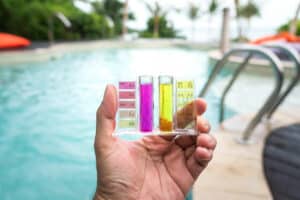 Water chemistry is the foundation of commercial pool maintenance. A larger number of swimmers introduces more contaminants into the water at a faster rate than a residential pool experiences. Sunscreen, sweat and body oils deplete chlorine quickly and throw off your pH balance.
Georgia law requires commercial pool operators to test free chlorine and pH at least twice daily during operation. That’s a minimum. If your pool sees heavy use during peak hours, more frequent testing gives you a more accurate picture so you can make smaller, more precise adjustments rather than overcorrecting.
When testing your commercial pool’s water chemistry, make sure to monitor the following key parameters to ensure they remain in their target range:
Keeping detailed records of every test is also a Georgia requirement. Your logs need to document results, the time of each test and any corrective actions you took. If your readings fall outside the required ranges, Georgia law requires you to close the pool and correct the chemistry before reopening.
Proper filtration and circulation are what keep your water chemistry stable between chemical treatments. Your pool’s circulation system continuously moves water through the filter, removing contaminants and distributing chemicals evenly. When your circulation system isn’t functioning properly, you get dead zones where water sits stagnant. Chemicals stop distributing evenly and bacteria can establish itself, even in a pool that tests clean at the surface.
Georgia sets turnover rate requirements for commercial pools based on pool class. The turnover rate refers to the number of hours it takes your system to filter the entire volume of water in the pool. Failing to maintain the required rate is classified as an imminent health hazard under Georgia law, which means a health inspector can require immediate closure. Verify the specific requirement for your pool class with the Georgia Department of Public Health.
To keep your system performing at the required level:
If you’re dosing chemicals correctly but getting inconsistent readings, your circulation system is worth investigating before adjusting your chemical routine.
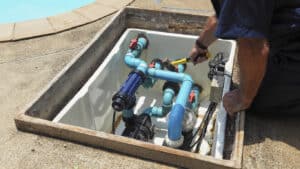 Commercial pool equipment works harder than residential equipment and shows wear faster. A pump failure or a broken chemical feeder can throw your water chemistry off within hours. Catching problems during a routine inspection is far less disruptive than discovering them during a health inspection or after your pool goes out of service.
Set a regular inspection schedule that covers your major equipment:
Drain cover compliance deserves special attention. The Virginia Graeme Baker Pool and Spa Safety Act requires commercial pools to install anti-entrapment drain covers that meet current ANSI/APSP standards. Drain covers degrade over time and need to be replaced when they show cracks, missing components or improper fit. A non-compliant drain cover is both a federal violation and a serious entrapment hazard.
Keeping a written equipment log makes it easier to spot developing problems, such as a pump that’s gradually losing pressure or a chemical feeder that requires frequent recalibration. These patterns often signal a failure before it happens.
Your commercial pool is subject to inspection by the local health authority at any time during operation. Seasonal pools that operate between April 1 and October 31 receive at least one inspection per season. Year-round pools are inspected at least twice per year, with additional unannounced visits possible at the health authority’s discretion.
An unsatisfactory inspection rating triggers a follow-up inspection within 30 days. Violations that don’t pose an immediate health hazard must still be corrected within that timeframe. Violations classified as imminent health hazards can result in immediate closure until the problem is resolved. Repeat or uncorrected violations can lead to suspension or revocation of your operating permit.
Thorough record-keeping is one of the most effective ways to demonstrate compliance. Georgia requires commercial pool operators to maintain detailed logs covering:
Your records need to be stored in a location that’s accessible to health inspectors. Complete your logs at the time of each activity rather than reconstructing them after the fact. Gaps in your documentation can raise questions during an inspection even when your pool is otherwise in compliance.
Georgia requires commercial pools to operate under the supervision of a properly trained operator at all times. Your facility also needs a designated responsible person available when the primary operator isn’t present. This person must be able to test water chemistry and close the pool when conditions require it. If your staff hasn’t completed formal pool operator training, your facility may not meet Georgia’s requirements.
Beyond the training requirement, documented procedures protect your operation when staff turns over. Written procedures give new employees a clear reference point and reduce the chance that steps get skipped during busy periods.
Your written procedures should cover:
Regular staff walkthroughs of your procedures help reinforce correct practices and give you an opportunity to catch any gaps between your written protocols and what’s actually happening on the deck.
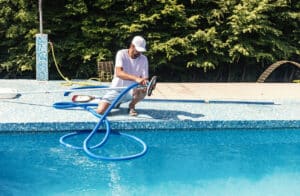 Routine maintenance tasks such as daily testing, filter backwashing and equipment checks are manageable with trained in-house staff. Some situations, however, call for professional expertise that goes beyond what a facility operator can address on their own.
Consider calling a commercial pool company when you notice:
Waiting to address these issues typically makes them more expensive to fix. A professional pool company can also identify developing problems before they become major repairs, reducing your long-term maintenance costs and minimizing the chance of an unplanned closure.
Allen Pool Service has been providing comprehensive commercial pool services throughout the Atlanta area since 1972. Whether you have one pool or multiple pools on several properties, we can help you develop the proper commercial pool maintenance plan that will keep your pool running properly and your guests safe.
Our technicians will work closely with your team to ensure all work is completed on schedule and within your budget. We know all the local, state and state laws governing commercial pool maintenance, and our team will make sure you remain compliant at all times. At Allen Pool, we’re committed to taking the hassle out of commercial pool maintenance.
Contact us today to schedule an appointment. Allen Pool provides commercial pool services throughout the Atlanta area.
How often should a commercial pool be tested?
Georgia requires commercial pool operators to test free chlorine and pH at least twice daily during operation. If your pool sees heavy use during peak hours, more frequent testing gives you a more accurate picture of your water chemistry. All test results must be logged along with the time of each test and any corrective actions taken.
What is the required turnover rate for a commercial pool in Georgia?
Georgia sets turnover rate requirements based on pool class. The turnover rate refers to the number of hours it takes your filtration system to process the entire volume of water in the pool. Failing to maintain the required rate is classified as an imminent health hazard under Georgia law and can result in immediate closure. Contact the Georgia Department of Public Health to verify the specific requirement for your pool class.
What are the most common commercial pool health code violations in Georgia?
Violations that commonly result in unsatisfactory inspection ratings include:
How often should commercial pool equipment be inspected?
Skimmer baskets and pump strainer baskets should be checked daily. Pumps, motors, chemical feeders and heaters should be inspected on a regular schedule — weekly or monthly depending on the equipment and usage level. Drain covers should be inspected for cracks, missing components or improper fit and replaced immediately if they no longer meet current ANSI/APSP standards.
Does a commercial pool in Georgia need a certified pool operator?
Georgia requires commercial pools to operate under the supervision of a properly trained operator at all times. Your facility also needs a designated responsible person available when the primary operator isn’t present. This person must be able to test water chemistry and close the pool when conditions require it.
Please call (770) 451-1621 to for pool renovation, service, and winterization by Allen Pool Service in Atlanta.
Request Now